
Urban trees in Poland face a range of disease pressures that differ meaningfully from those affecting forest stands. Compacted soils, road salt, restricted root zones, and elevated temperatures in built-up areas weaken tree defences and create conditions in which pathogens thrive. Recognising disease early is the first step toward decisions about treatment, monitoring, or removal.
This article covers the diseases most frequently encountered by municipal tree managers and arborists working in Polish cities, with guidance on visual identification and references to further diagnostic resources.
Chalara Ash Dieback (Hymenoscyphus fraxineus)
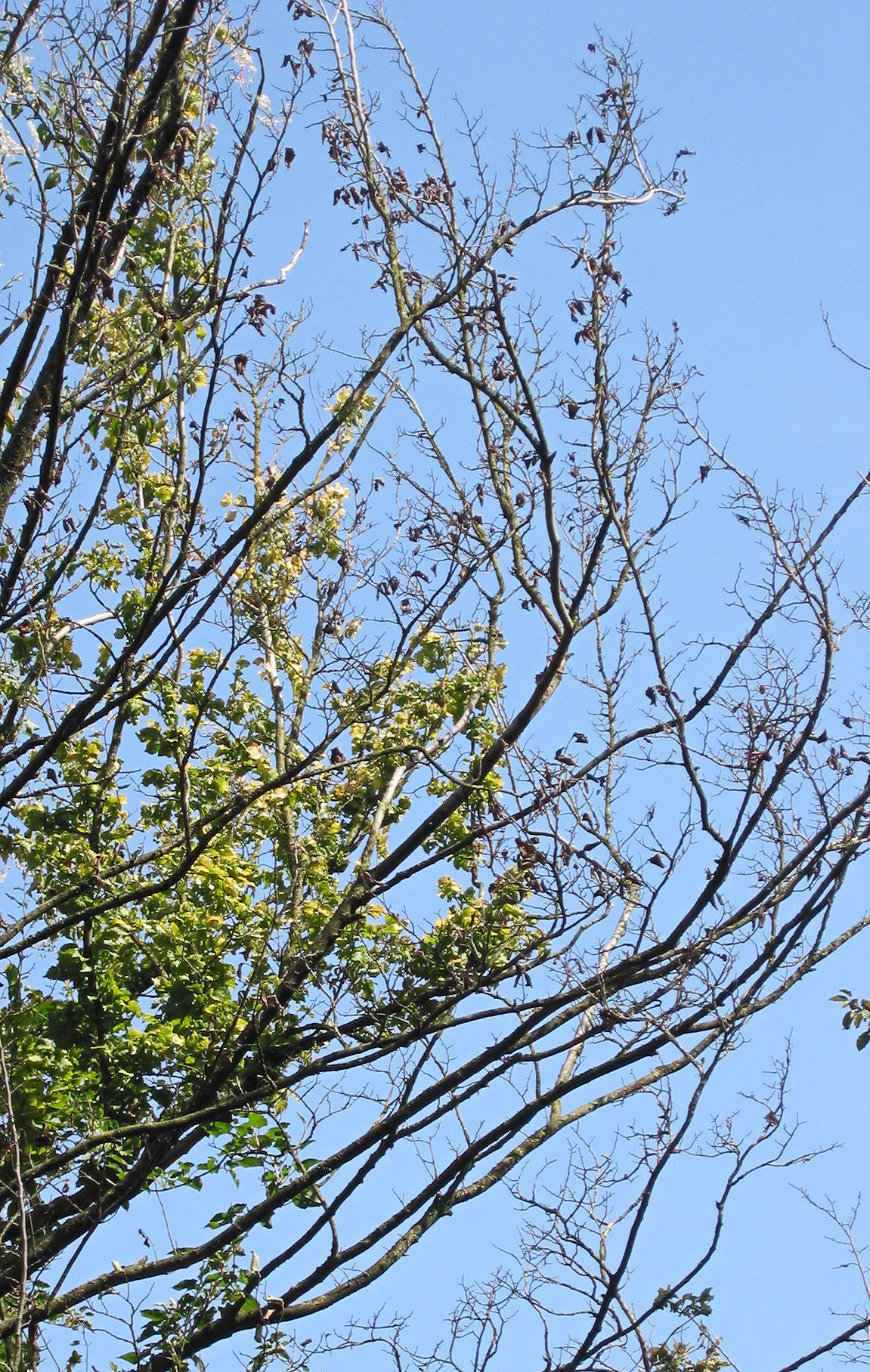
Ash dieback is the most significant tree disease currently affecting Poland's urban and rural landscape. The pathogen Hymenoscyphus fraxineus (previously known as Chalara fraxinea) is now widespread across the country following its arrival in Poland in the 1990s. It primarily affects European ash (Fraxinus excelsior) and narrow-leaved ash (Fraxinus angustifolia).
Visual Signs
- Wilting and browning of leaves beginning at the tips and margins, spreading back toward the rachis
- Dark brown to black lesions at the base of leaf stalks
- Diamond-shaped necrotic lesions on young shoots, often with a tan centre and dark border
- Epicormic shoots from the lower trunk in later stages — an attempt to compensate for canopy loss
- White to cream-coloured fruiting bodies (apothecia) on fallen infected rachises in summer
Management Note
There is currently no chemical treatment that eliminates Hymenoscyphus fraxineus from an infected tree. Management focuses on monitoring, hygiene (removing infected material from site), and retaining trees that show evidence of natural tolerance. The Polish State Forests (Lasy Państwowe) and the Institute of Forest Research (IBL) in Raszyn maintain monitoring data on ash dieback spread.
Dutch Elm Disease (Ophiostoma ulmi / O. novo-ulmi)
Dutch elm disease, caused by the Ophiostoma fungi and spread primarily by bark beetles (Scolytus spp.), devastated elm populations across Europe in two major waves during the 20th century. In Poland, O. novo-ulmi — the more aggressive strain — remains present, though surviving elm populations have reduced the density of suitable host material in many areas.
Visual Signs
- Sudden wilting and yellowing of leaves on individual branches, beginning in late spring or summer — termed "flagging"
- Discolouration of the sapwood: a brown staining visible in cross-section, following the vascular system
- Gallery patterns beneath the bark created by feeding bark beetles — visible after removal of a bark section
- Rapid progression from flagging to whole-crown death over one or more growing seasons
Phytophthora Root and Collar Rot
Several Phytophthora species attack the roots and root collar of urban trees, particularly where soils remain waterlogged for extended periods or where irrigation is excessive. Commonly affected species in Poland include horse chestnut, beech, linden, and oak.
Visual Signs
- Gradual decline of the crown — sparse foliage, reduced leaf size, early autumn colouring
- Dark, water-soaked lesions at the base of the trunk, sometimes extending several centimetres up the stem
- Reddish-brown staining in the cambium layer when bark is removed from the collar area
- Bleeding cankers: dark resinous exudate at the collar in species such as horse chestnut and beech
Phytophthora infections are often triggered or worsened by soil compaction, over-irrigation, or the use of organic mulch piled against the trunk. Improving drainage and keeping the root collar free of debris reduces risk.
Horse Chestnut Leaf Miner (Cameraria ohridella)
This insect pest — a small moth whose larvae feed within the leaf tissue of horse chestnut (Aesculus hippocastanum) — has been established in Poland for over two decades. It does not kill trees directly, but repeated severe infestations weaken them and make them more susceptible to secondary pathogens such as Guignardia aesculi (leaf blotch).
Visual Signs
- Brown, papery mining damage within the leaf blade, initially appearing as small blotches expanding into larger irregular patches
- By midsummer, severely affected trees appear prematurely autumnal — leaves brown and shrivelled while still on the tree
- Multiple generations per year mean damage accumulates through the growing season
Practical Management
The most effective widely applicable measure is collection and destruction of fallen leaves in autumn, which removes the overwintering pupae. Many municipalities in Warsaw, Kraków, and Poznań now include horse chestnut leaf collection as part of their autumn maintenance schedules specifically for this reason. Biological control agents and trunk injection options exist but are applied selectively due to cost and complexity.
Bark Beetle Infestations in Urban Context
Several bark beetle species (Scolytidae) affect urban trees in Poland, though the scale of damage is generally smaller than in managed forestry. Ips typographus, a significant pest of Norway spruce, has expanded its range in recent years partly due to drought stress. Urban spruce and pine plantings in parks are affected.
Trees under stress — from drought, soil compaction, physical damage, or disease — are significantly more susceptible to bark beetle colonisation. Maintaining tree health through appropriate planting and management reduces this risk more reliably than reactive treatment.
Signs of Active Bark Beetle Activity
- Fine reddish-brown boring dust (frass) at bark crevices or on the ground below
- Small circular or oval entry holes in the bark
- Gallery patterns visible when bark sections are removed
- Resin pitch tubes on conifers where the tree has attempted to expel beetles with resin
Confirming a Diagnosis
Many disease symptoms overlap. Crown thinning, premature leaf drop, and bark lesions can result from abiotic stress (drought, salt damage, physical injury), soil problems, or multiple concurrent issues rather than a single pathogen. Reliable diagnosis often requires laboratory analysis of symptomatic tissue.
Reference laboratories and plant health inspection services in Poland:
Last updated: May 2025